Witness
$19.99
a year, one account
- Everything in Witness, on every device you sign in to
- The browser app, and the iPhone and iPad apps
- One month free, then $19.99 a year
Started here in your browser, or in the app.
Family history, in your browser
Witness reads your GEDCOM file and gives back the thing a tree cannot show you on its own — who these people were, where they stood, and what the record actually says about them.
Free sneak peek, no account needed. Also available on the App Store.
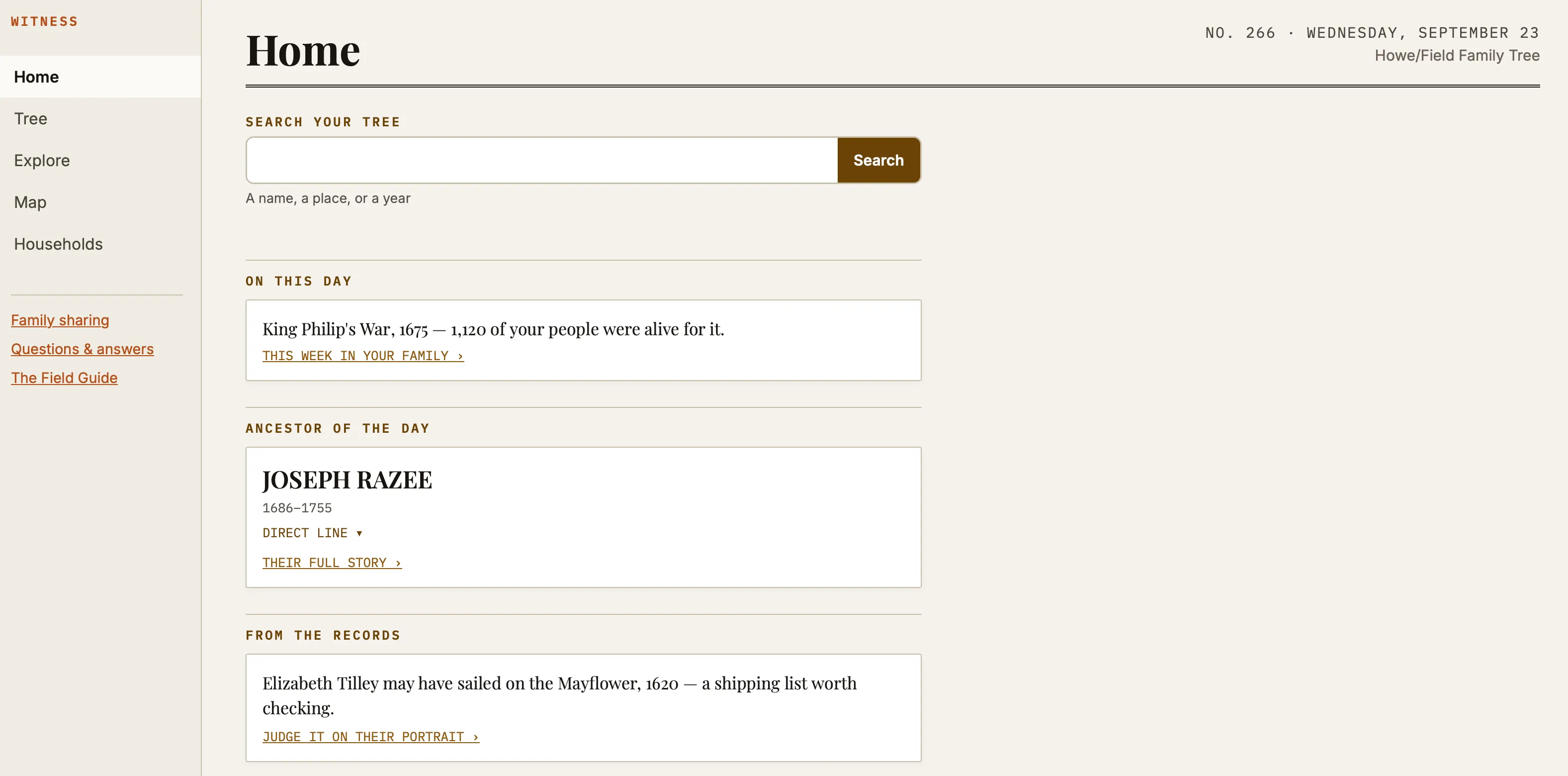
Ancestry, FamilySearch, MyHeritage, Findmypast, or desktop software
.ged file
Reads it — never writes back
Fix what is wrong where you built it, export again, and bring the new file back through Update from a newer file. Witness merges it and shows you what changed.
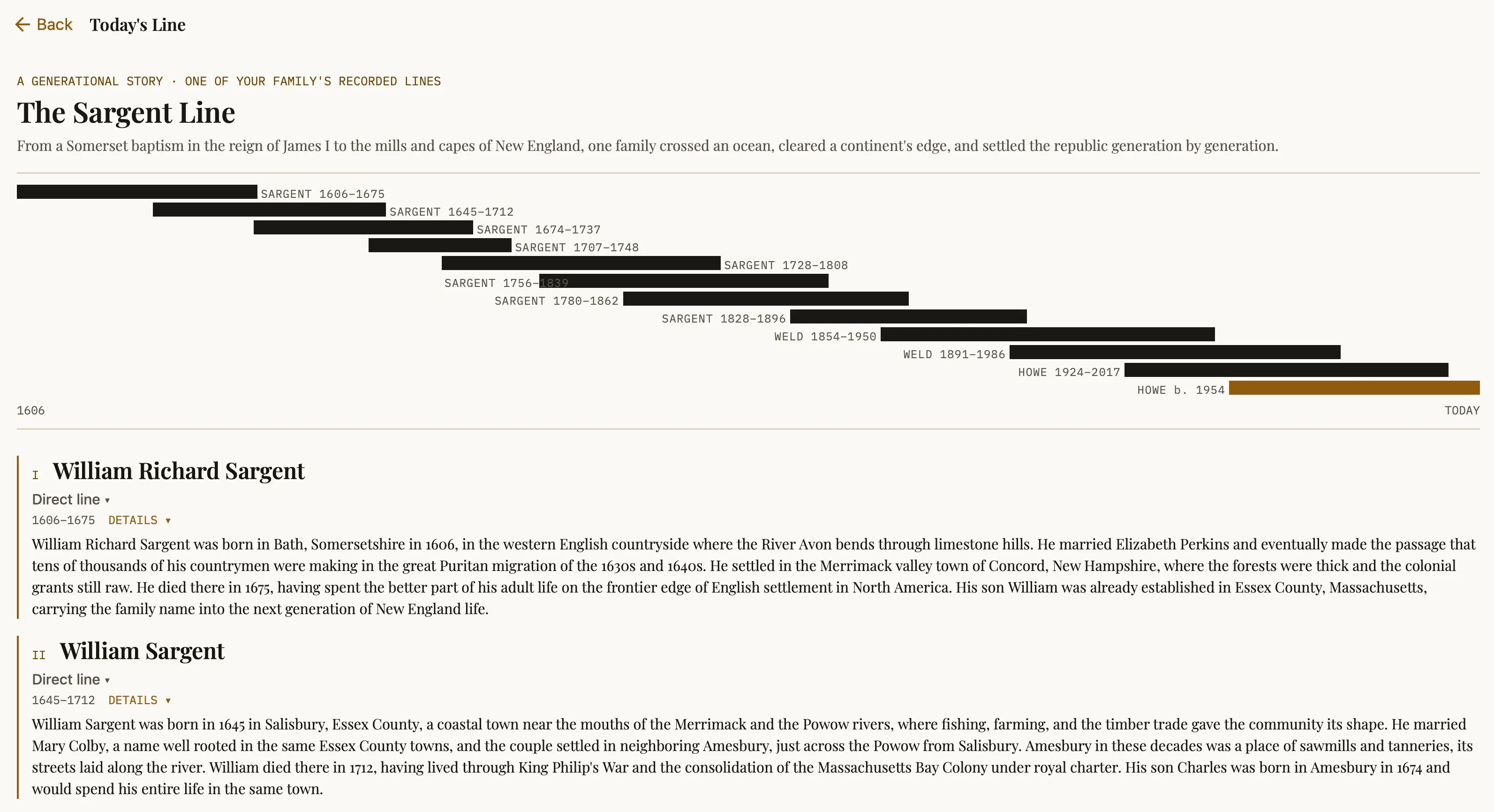
Their story
Witness writes the story of a line down the generations — where they were born, what they crossed, what the census found them doing. Every sentence is drawn from your own record. Where the record is silent, the story says so rather than filling the gap.
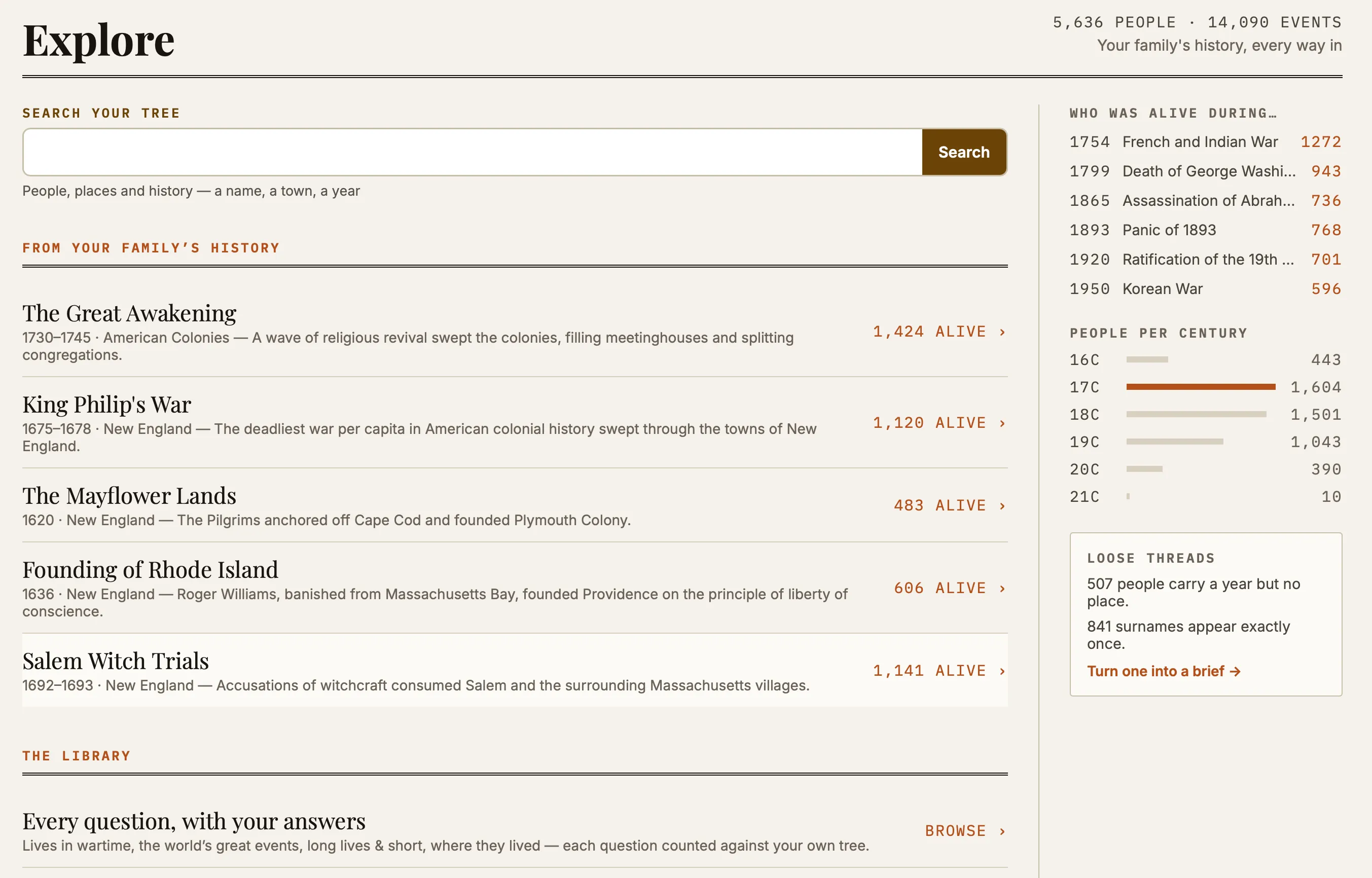
Explore
One page that opens onto everything: search that reads the words you type in any order, the moments your family actually lived through with a live count beside each, and how many of them each century holds.
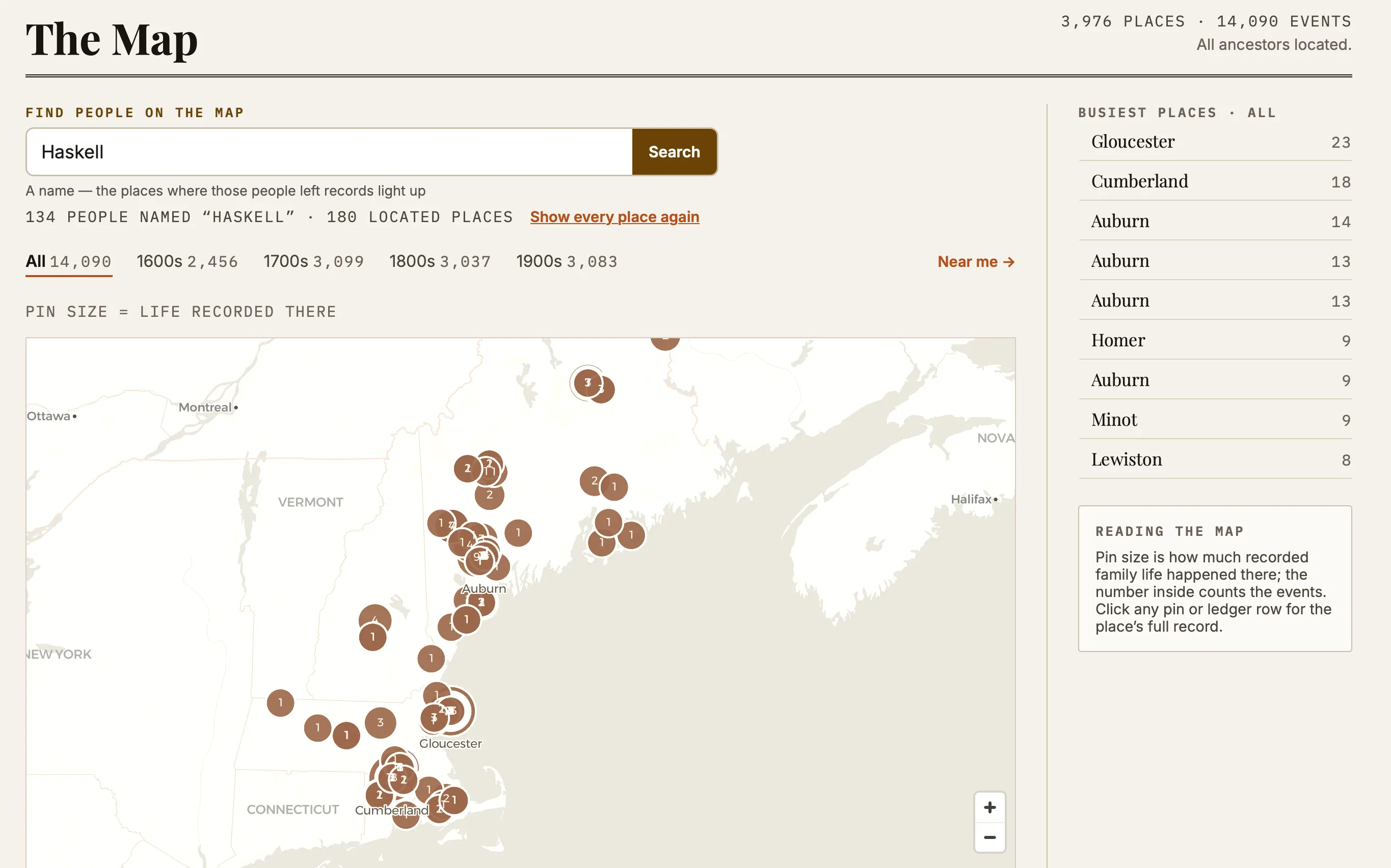
The Map
Every town, parish and county your family was recorded in, placed on a map you can move through by century. Coordinates are worked out after the import, so a large tree fills in over a couple of hours.
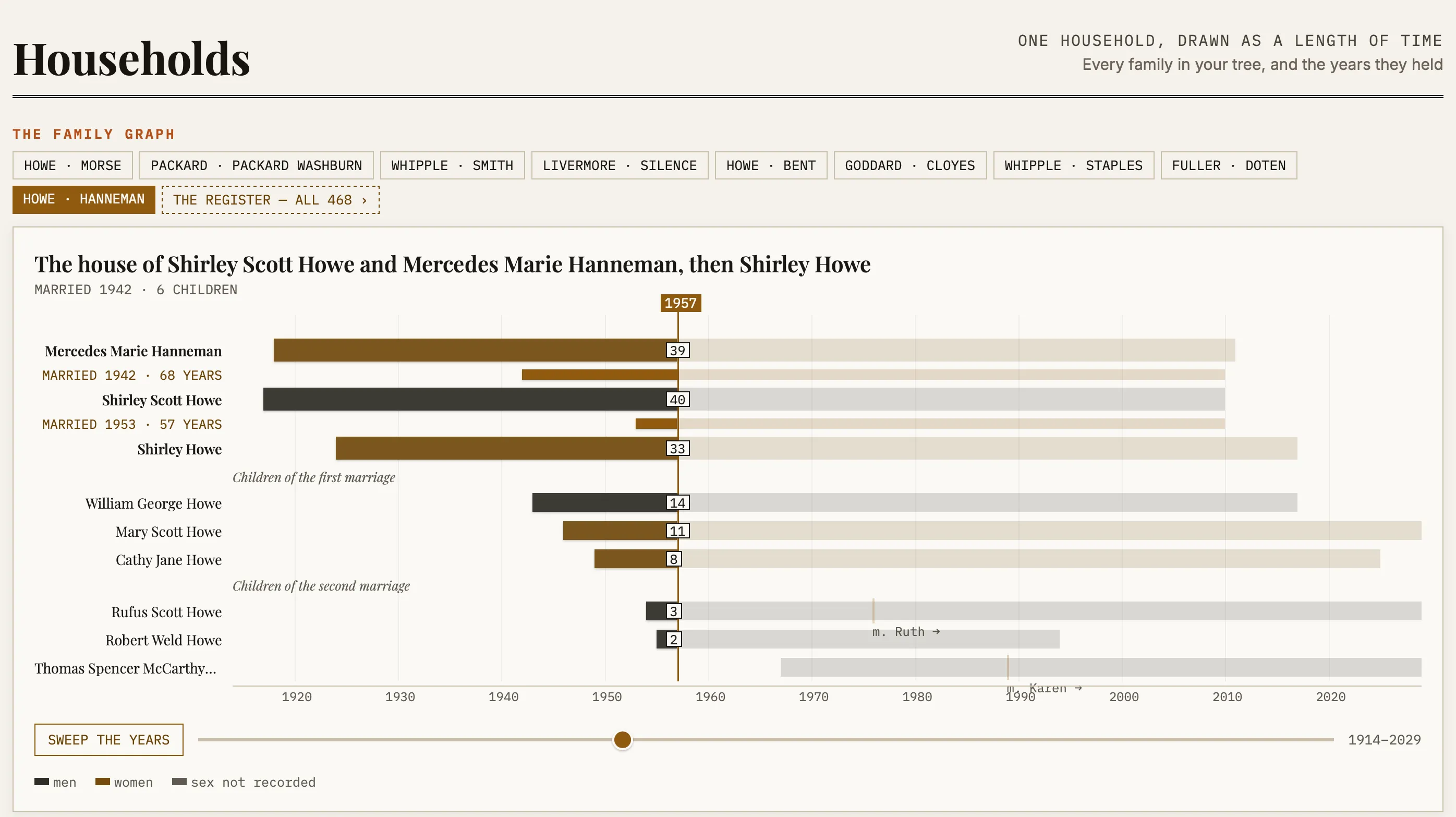
Households
A family drawn as the years it held: every life a bar, marriages marked, children ranked beneath their parents. Sweep the years and read everyone's age at any moment in the household's life.
Tree health
The standard tests a serious genealogist runs on a tree — twenty-four of them, over every person, family and date in your file. They catch what is impossible rather than merely unlikely: a death before a birth, a marriage before a spouse turned thirteen, a parent too young to be one.
Beside them sit the loose threads: the people a small piece of work would finish.
Loose threads
507 people carry a year but no place.
841 surnames appear exactly once.
From one real tree of 5,636 people.
The Library
45 ready-made questions you can ask of your own family data — who was alive during the Revolution, who lived through the Depression, who went furthest from where they started — alongside 48 historical events to check your family against.
Every question shows a real count from your own tree before you open it. The library grows without waiting for an app update, so there are more of both by the time you read this.
Drop your GEDCOM in and Witness reads it in your own browser — no account, no upload, nothing sent anywhere. You see your own counts, the moments your family lived through, and what contradicts itself, before you decide anything.
Start the sneak peekWitness is a game changer for me! I learn new things every day.
I’m totally obsessed with Witness. I had no idea that all these things happened to my family. Looking at a tree alone doesn’t bring it all together for me.
I’m a stickler for facts. The storytelling doesn’t use filler that isn’t true, and the historical context adds so much to what my ancestors dealt with.
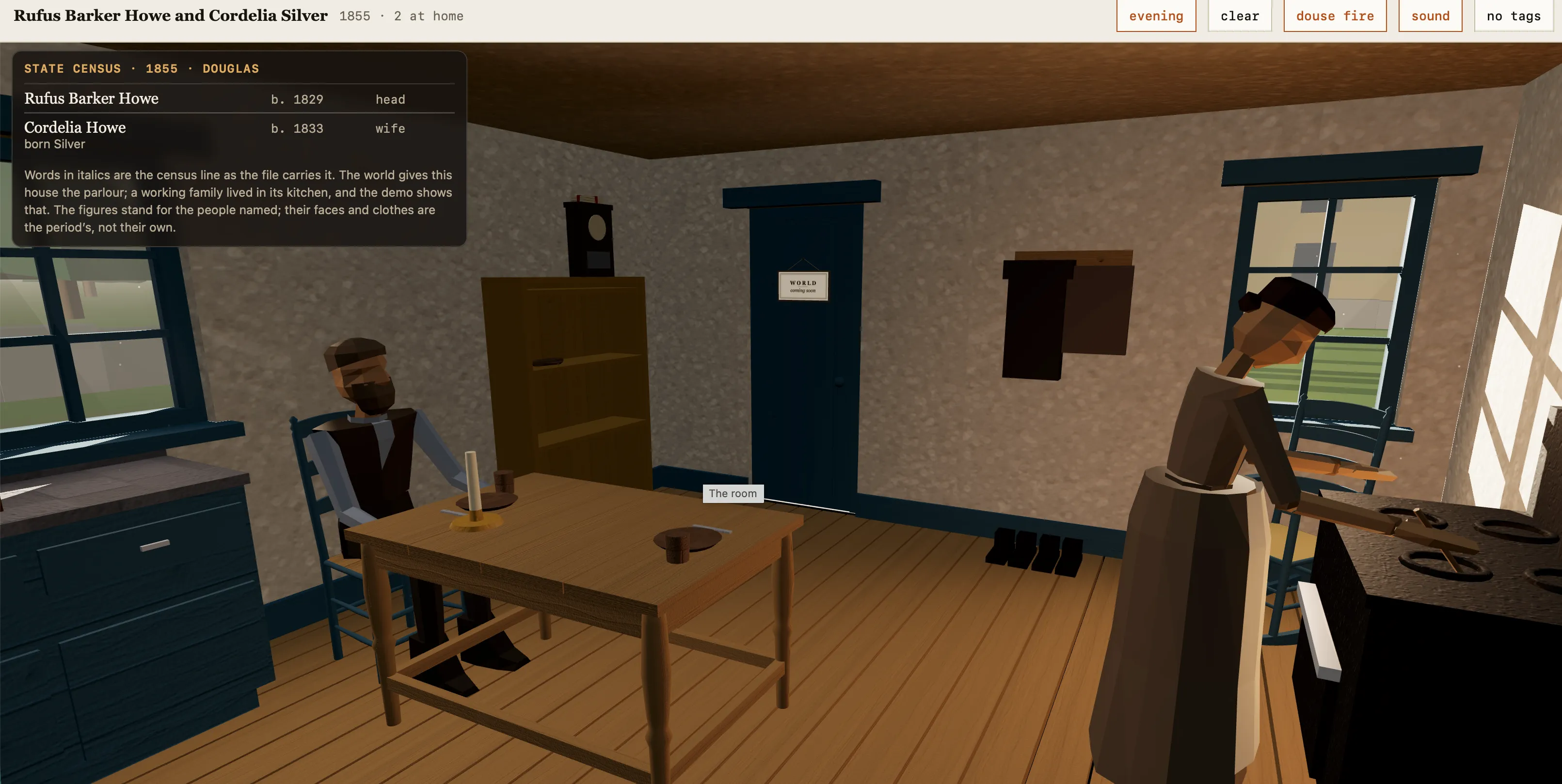
Stand in the room your family lived in, on a day the census found them at home — the hour, the weather, the fire, the furniture of that place and period. It is open to a small group of readers while we learn what it wants to be.
The rooms are built from the record and furnished from a catalogue of the period; the people in them are stand-in figures, not portraits.
Witness
$19.99
a year, one account
Started here in your browser, or in the app.
Witness Family
$29.99
a year, up to five accounts
Started here in your browser, or in the app.
A card is required to start the free month. Nothing is charged until the month ends, and you can cancel from your account settings at any time.
One subscription
Subscribe here and the apps are yours too. Download Witness free from the App Store, sign in with the same email, and you are already a subscriber — there is nothing more to pay and nothing to restore.
The iPhone and iPad apps add what a phone can do that a browser cannot: read a headstone at the graveside, and keep your original file in an encrypted vault.
On your phone
I spent my career building expert systems for healthcare — messy records and missing data weren't exceptions, they were most of the job. Genealogy software never seemed to catch up to that. So I built the thing I wanted to use.
Rufus Howe, who built Witness
Witness is read-only. Your GEDCOM file, and your tree on Ancestry, FamilySearch or anywhere else, are never altered. What you record here — a stone read at the graveside, a note, a confirmed crossing — stays in your Witness copy alone.
The tree's structured facts — names, dates, places, sources — are held in your account so the app can query them. Nothing about a living person is ever included in anything shareable.
Your original file is sealed with an AES-256 key generated on your iPhone and held in the iOS Keychain, then uploaded as an unreadable blob. We store it and cannot open it. You are shown a recovery code once, to save: it restores your file on another device, and it is the only thing that can. We do not hold a copy, which is the whole point, and also the risk — lose your device and your recovery code, and the stored file is unrecoverable ciphertext.
One honest limit: that vault relies on the iOS Keychain, which has no browser equivalent. There is no vault at all in the browser version, rather than a weaker one pretending to be the same thing. Your tree still imports and works; the original file is simply not kept for you.